Miqat
Miqat is a free prayer times display from Inspirnex, made for the screen on a mosque wall and for any Smart TV, tablet or phone with a browser. Nothing to install: open mymiqat.com, allow location, go fullscreen. 16 languages, 12 calculation methods, and Islamic borders and patterns in the mosque's own colour.
- Venture
- Miqat
- Years
- 2026 to present
- Sector
- Faith and community
- Scope
- Product design, Brand identity, Web development
- Website
- mymiqat.com
The idea
A mosque needs one thing on its wall: today’s prayer times, readable from the back row. The usual answers are a hardware box with a subscription, an app that wants an account, or a printed sheet that is wrong by Thursday. Miqat is the fourth answer: a free prayer times display that runs in the browser a Smart TV already has. Open mymiqat.com, allow location, press fullscreen, and the wall is done. The same page serves a tablet by the door or a family’s phone at home.
The name is the Arabic word for an appointed time and place, the boundary set for an act of worship, and the product takes it literally: it shows the appointed times, and nothing on the screen competes with them. I built Miqat under Inspirnex in March 2026 as one page, and every decision below is about making that page right at ten metres.
Brand
The mark is a mosque dome with a finial and, inside it, a clock face with its hands: one shape, because the product is one idea, the time of prayer. The wordmark reads MIQAT in wide capitals beneath, the name is written Miqat and ميقات, and the brand colour is a gold, #eabf1e.
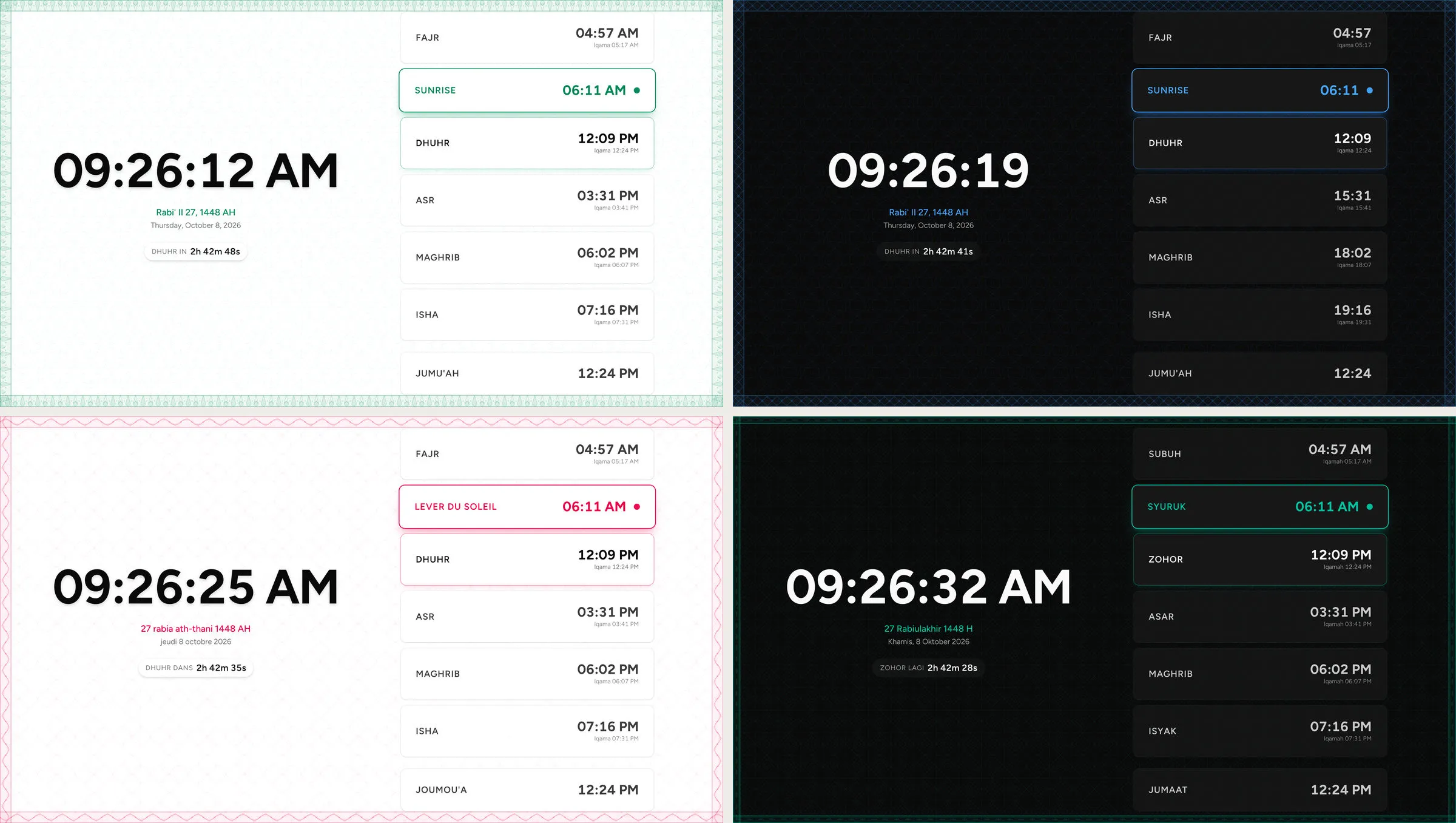
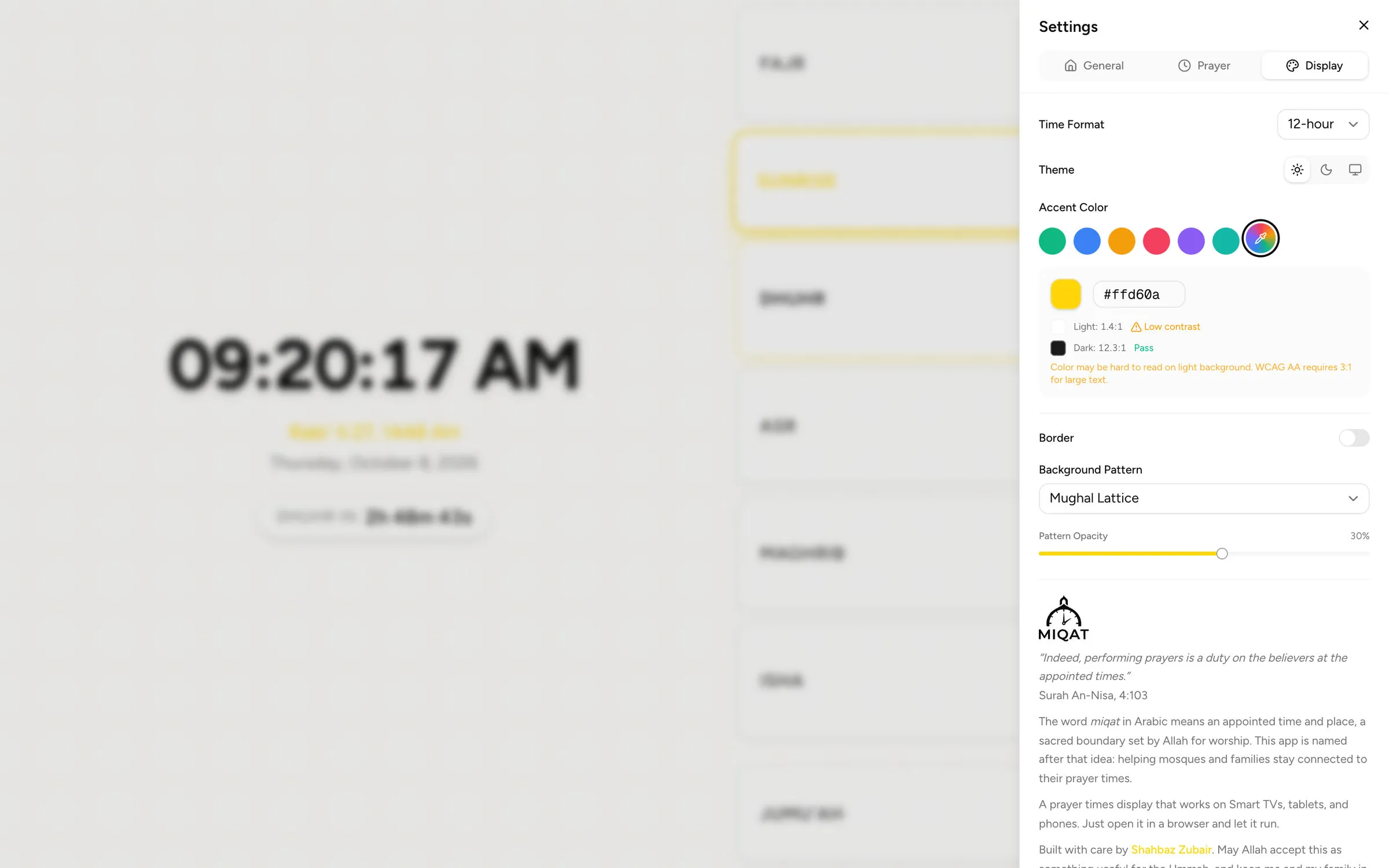
Inside the display the gold steps aside for the mosque’s own accent: six presets, Emerald, Blue, Amber, Rose, Violet and Teal, or any colour a mosque already uses. Every accent has two tunings, deeper for light and brighter for dark, so the same green reads on white by day and on black at night. A custom colour is checked against both backgrounds as it is typed, and the panel says when it falls under the 3:1 that large text needs. Amber is the default.
The type is Figtree. Prayer names are capitals with wide tracking so they hold their shape at distance, and every time is set in tabular figures so the column never shivers as the minutes change. Arabic, Urdu and Persian switch the display to Noto Kufi Arabic.
Product
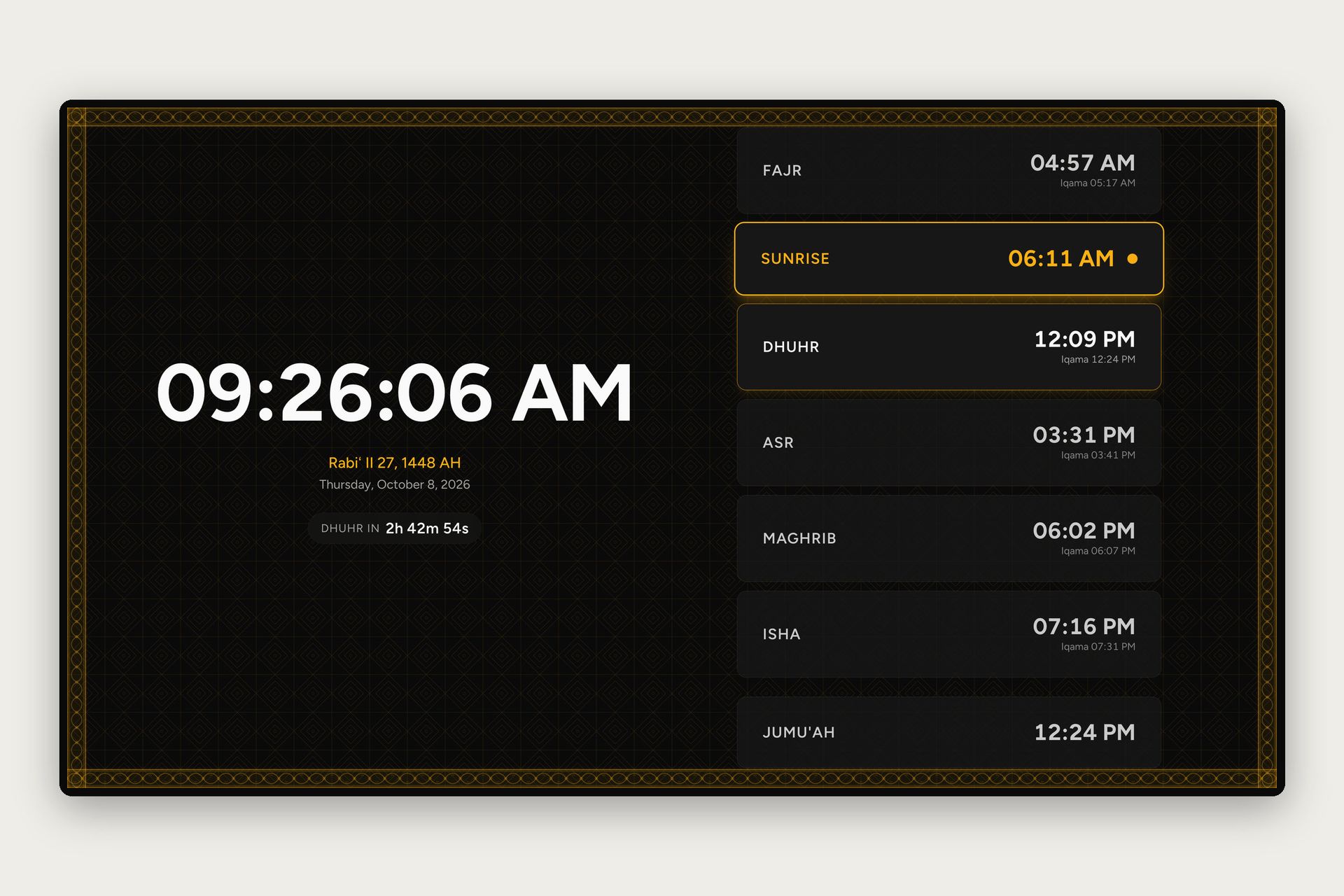
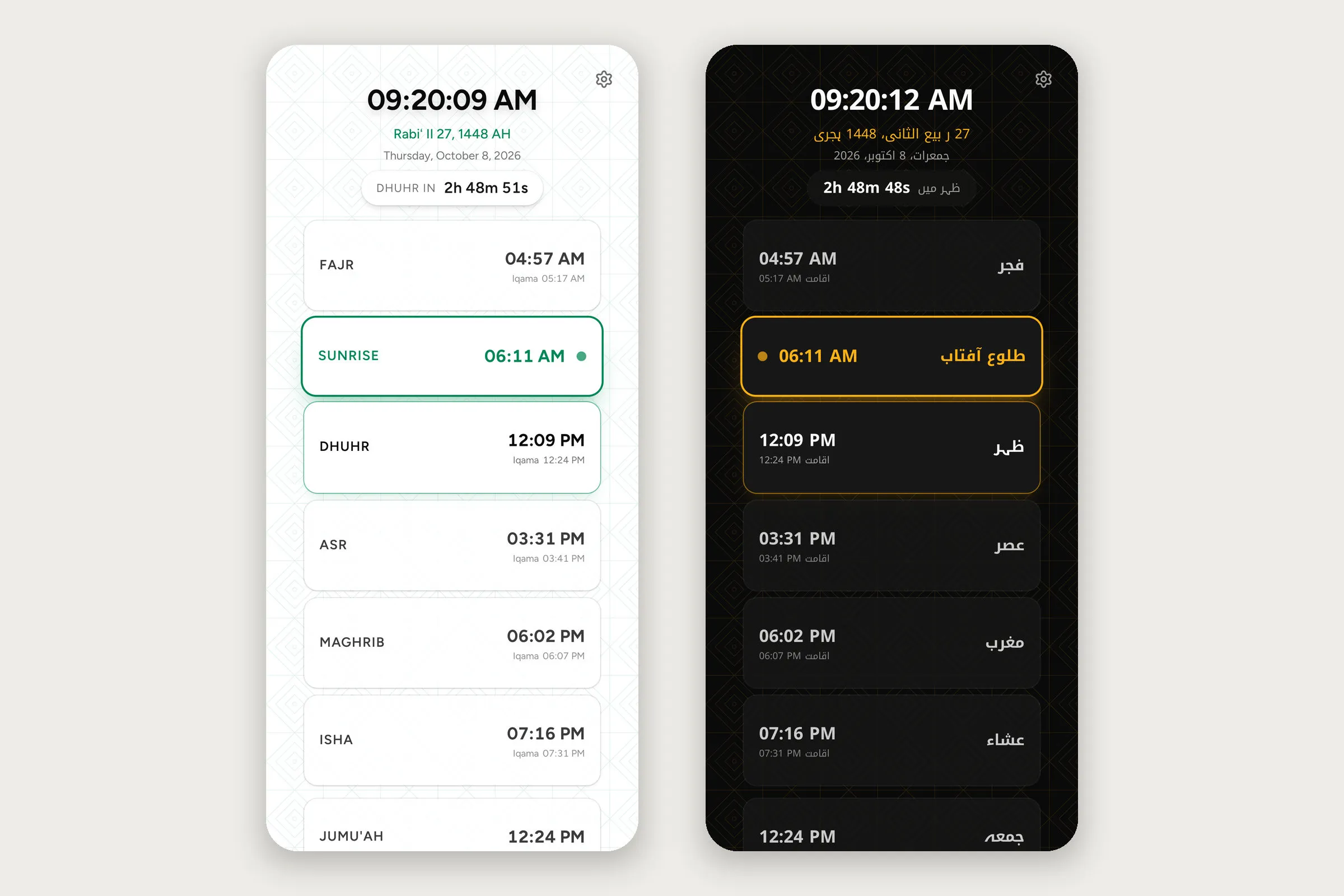
The display is one screen in two columns: the mosque’s name, the clock at the largest size the screen allows, the dates and a countdown on the left; a card for each prayer with its Adhan time and the Iqama beneath on the right, and Jumu’ah on a card of its own at the foot. On a TV the page locks to the screen and never scrolls. On a phone the columns stack, clock first.
The current prayer is the only loud thing on the screen. Its card takes the accent colour, a ring and a pulsing dot. The next prayer gets a faint ring. Every other card drops to eighty percent. From the back row you read one card first, and it is the right one.
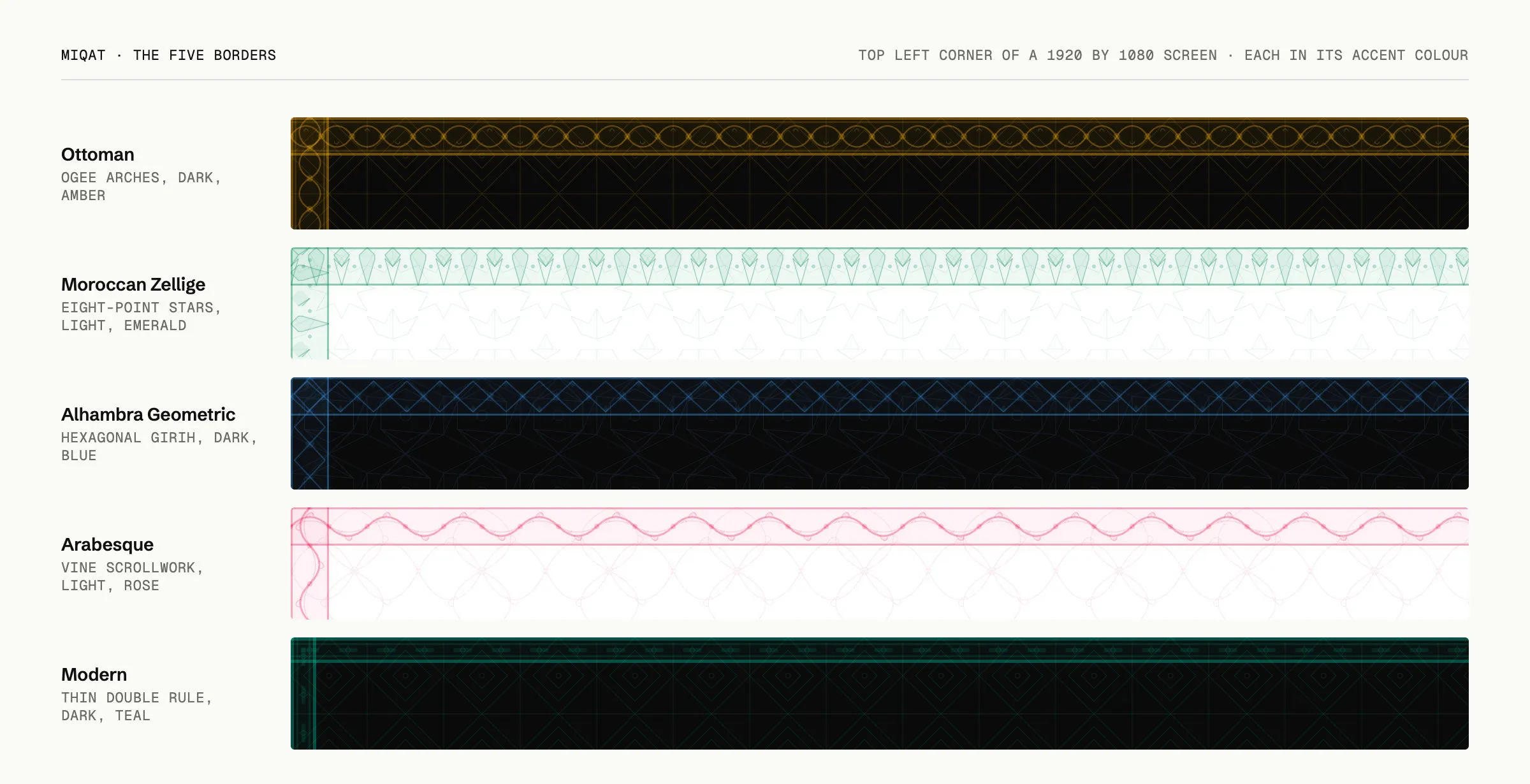
The ornament is drawn, not photographed. Five borders, each a vector pattern in the accent colour: Ottoman ogee arches after the Blue Mosque, Moroccan zellige with its eight-point stars, the hexagonal girih of the Alhambra, Arabesque vine scrollwork, and a plain Modern double rule. Behind the content a fainter pattern tiles the screen, stars, hexagons, vines or a Mughal lattice, at an opacity the mosque sets. Geometry stays crisp at any size and recolours with one tap.
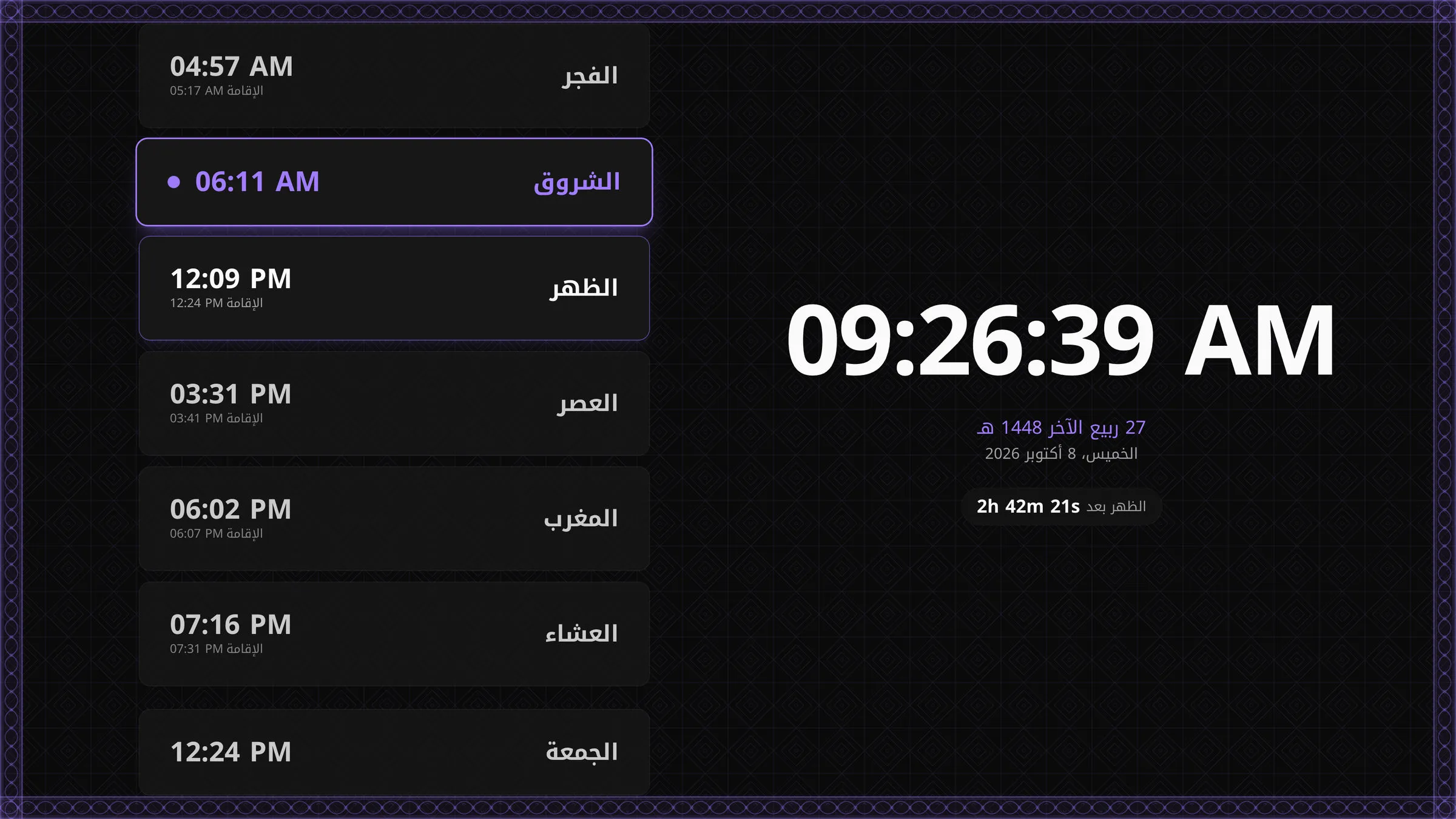
Right-to-left is a layout, not a translation. Choose Arabic, Urdu or Persian and the columns swap sides, the cards align right and the type becomes Noto Kufi Arabic. Digits stay left-to-right inside the right-to-left line, because 06:11 reads the same way in every language. The settings panel stays left-to-right in every language, so the controls never move.
A bilingual mode sets English and Arabic side by side. Sixteen languages in all, Turkish, Malay, French, Bengali, Tamil, Hindi, Somali, Swahili, Hausa and Malayalam among them, each with its own words for the prayers.
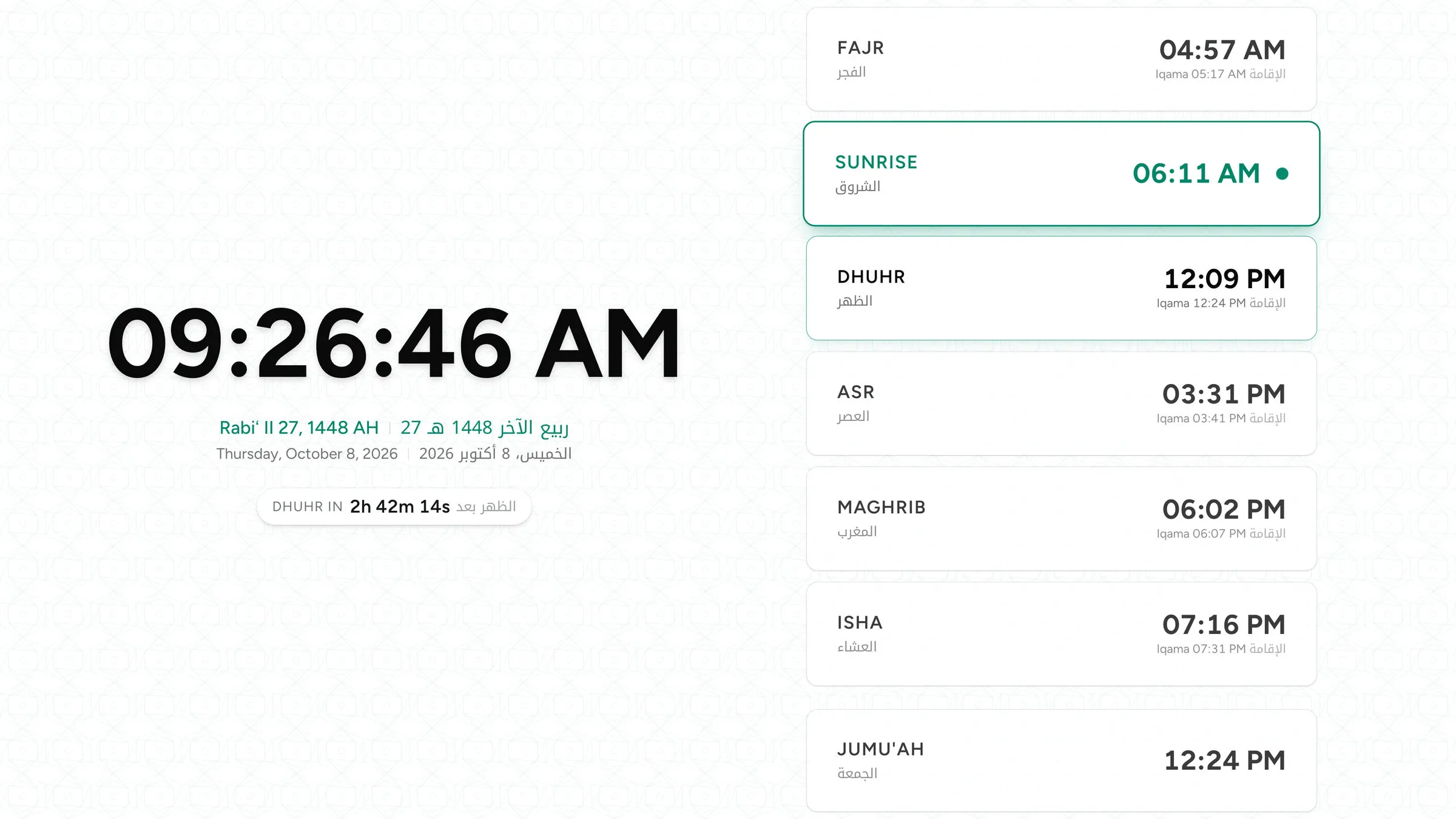
The calculation belongs to the mosque: twelve methods, from Muslim World League and Umm Al-Qura to Diyanet and the Moonsighting Committee, and the madhab that decides Asr. Iqama is an offset per prayer, Jumu’ah a fixed time or minutes after Dhuhr, and the Hijri date can move two days either way to match the local sighting.
Location is asked of the browser once and stays on the device; when a TV cannot answer, its time zone is enough to place a city. There is no account, and the settings live on the screen that set them.
When a prayer time arrives the whole screen becomes the announcement: a pulsing circle in the accent colour and the prayer’s name at its largest, for thirty seconds or until someone touches the screen.
Miqat is live at mymiqat.com, free for any mosque or home.
Principles
- One screen, one job: the times, readable from the back row.
- The current prayer is the only loud thing.
- Ornament is geometry in the mosque’s colour, never a picture.
- Right-to-left is a layout, not a translation.
- Nothing to install, no account, and location stays on the device.