Tallira
Tallira is Inspirnex's point of sale for shops, restaurants and cafés in Saudi Arabia and the UAE. One product in two editions: retail sells by barcode and keeps one stock count across every branch; counter picks from a grid and keeps no stock. Every sale is a tax invoice.
- Venture
- Tallira
- Years
- 2026 to present
- Sector
- Point of sale
- Scope
- Product design, Brand identity, Software development
The idea
A shop and a café buy the same thing, a register, and are sold two different products. One tracks stock and treats the tax invoice as a month-end export; the other is quick at the counter and knows nothing about a shelf. Both will let a cashier ring up a sale that never becomes an invoice. Tallira is one product for both counters, built on the rule the others bend: there is no sale without a tax invoice.
It is Inspirnex’s point of sale for businesses in Saudi Arabia and the UAE.
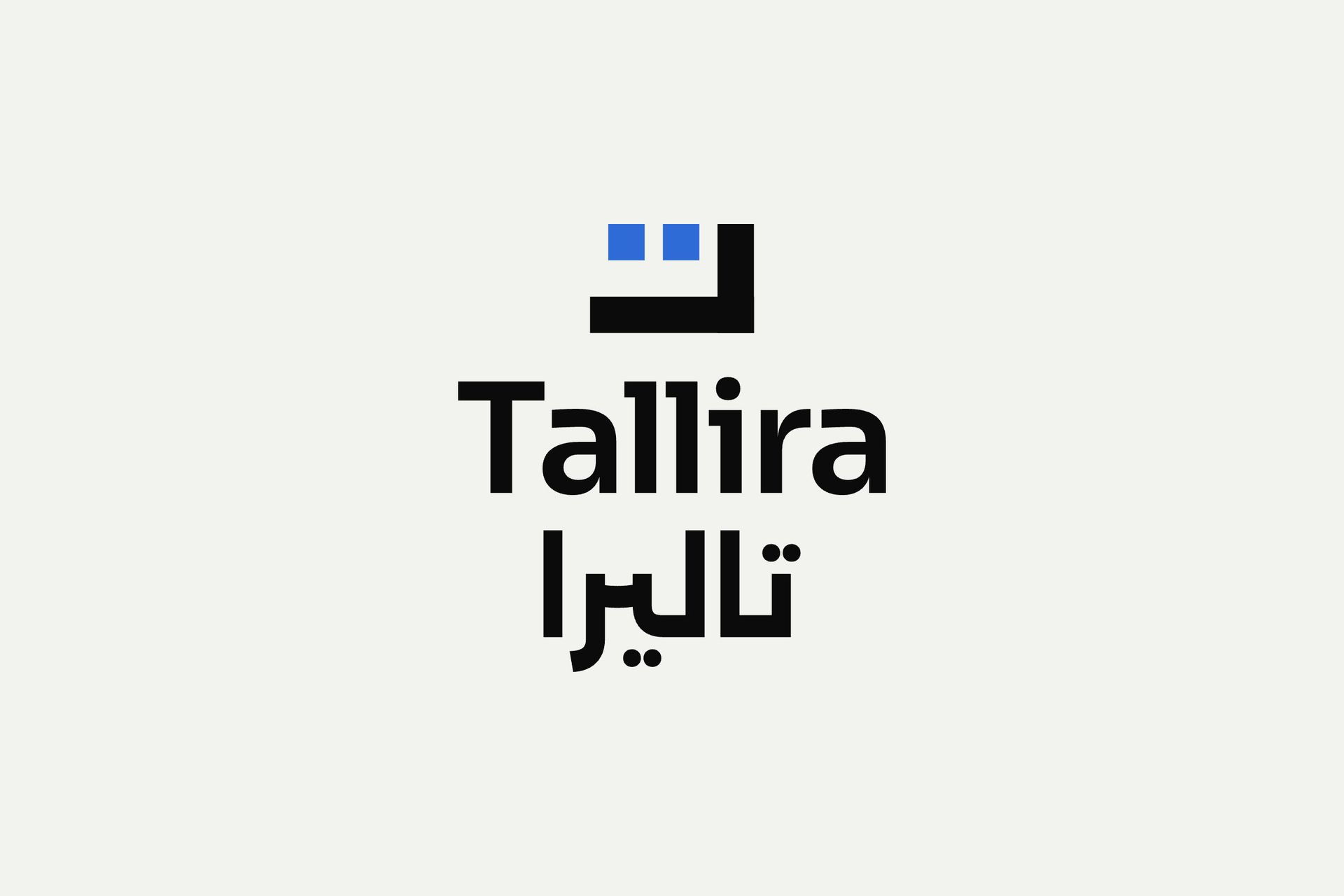
The name is coined. It means nothing in any dictionary, so it means only itself: Tallira, تاليرا, never in capitals.
Brand
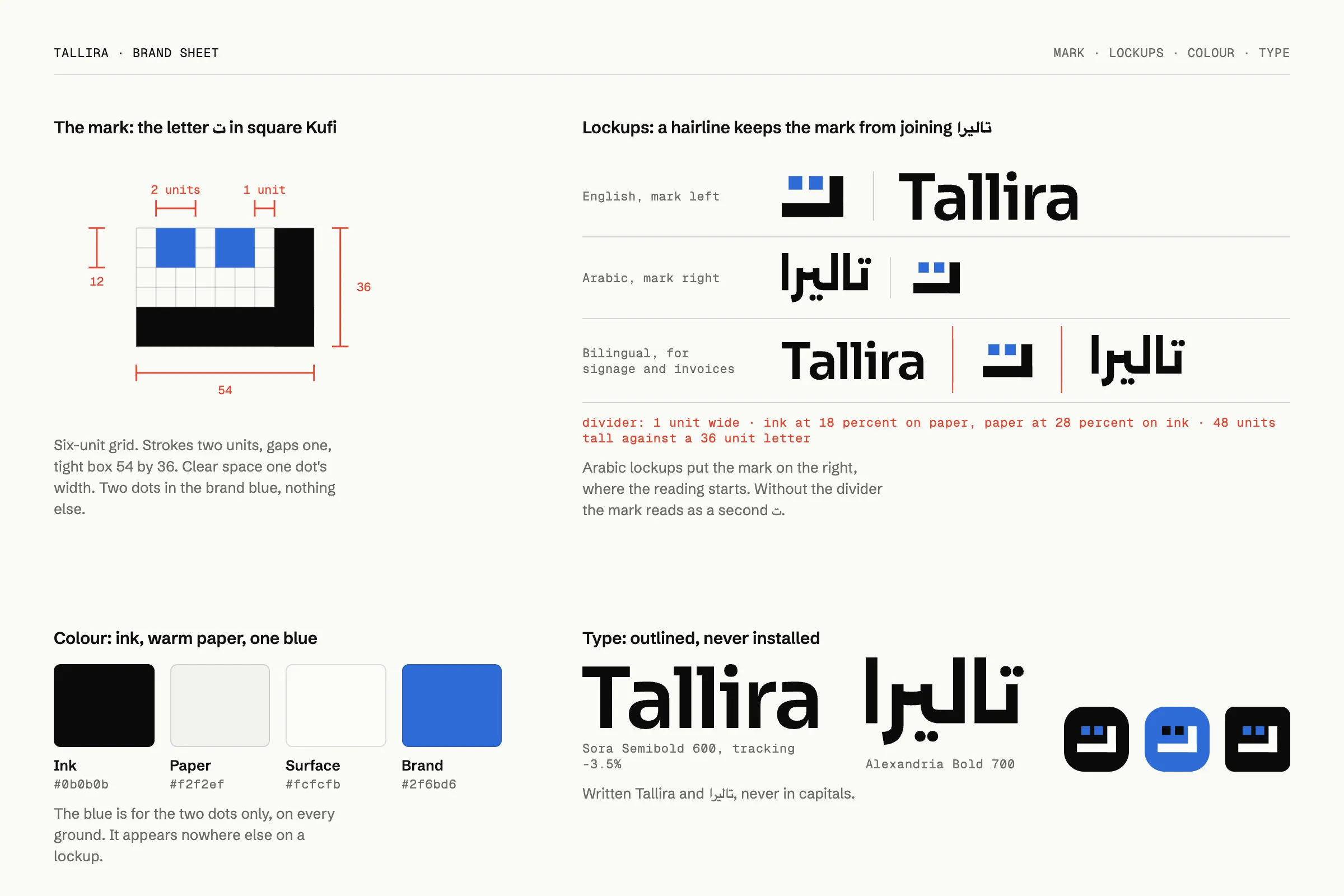
The mark is the letter ت in square Kufi: a baseline, a rise and two dots, the first letter of the name in Arabic. It sits on a six-unit grid, strokes two units and gaps one, in a tight box of 54 by 36. The two dots are the only colour in the brand, a blue, #2f6bd6. Everything else is ink, #0b0b0b, on warm paper, #f2f2ef, with #fcfcfb for surfaces.
Two wordmarks, Tallira in Sora Semibold and تاليرا in Alexandria Bold, are outlined to paths, so nothing depends on a font being installed. They lock up three ways: English with the mark on the left, Arabic with the mark on the right where the reading starts, and a bilingual line. One rule governs all three: a hairline divider, one unit wide, between mark and wordmark, because without it the ت joins تاليرا and reads as a second letter of the word.
Product
Five decisions carry the rest.
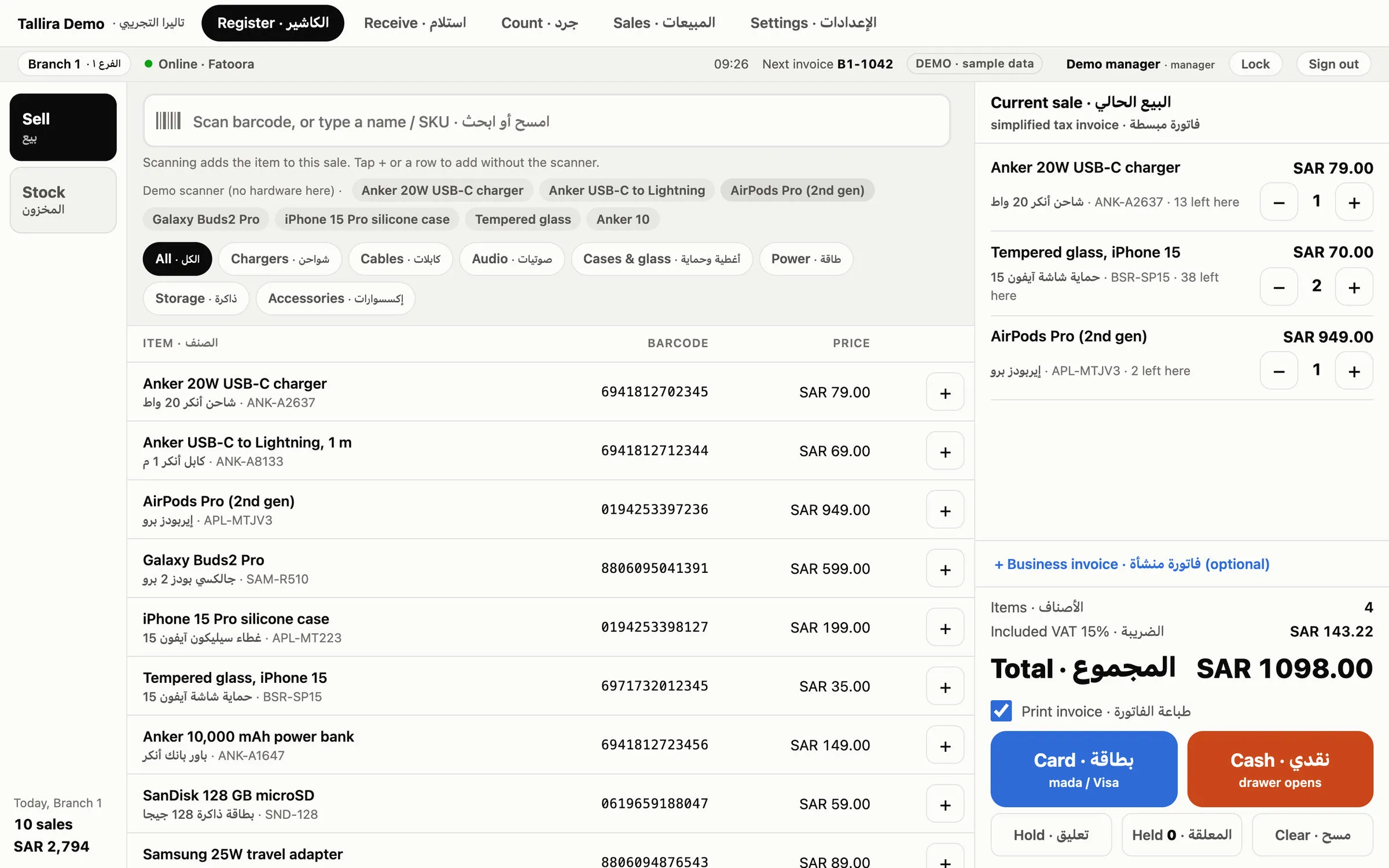
One product, two editions. Retail sells by barcode and keeps one stock count across every branch. Counter picks from a grid and keeps no stock, for a restaurant, a café, a fish market or a bakery. Retail puts a scan field where counter puts a grid; the bill, the number pad, held orders, promotions, invoices and reports work the same way in both, so a business that grows from one counter to many branches never relearns its register.
The counter is built for speed and two scripts. Items are large tiles with the English name, the Arabic name and the price; the two payment buttons, Card in blue and Cash in orange, are the biggest things on the screen. Every label is bilingual, “Sale · بيع”, “Cash · نقدي”, because the cashier and the customer do not always read the same script.
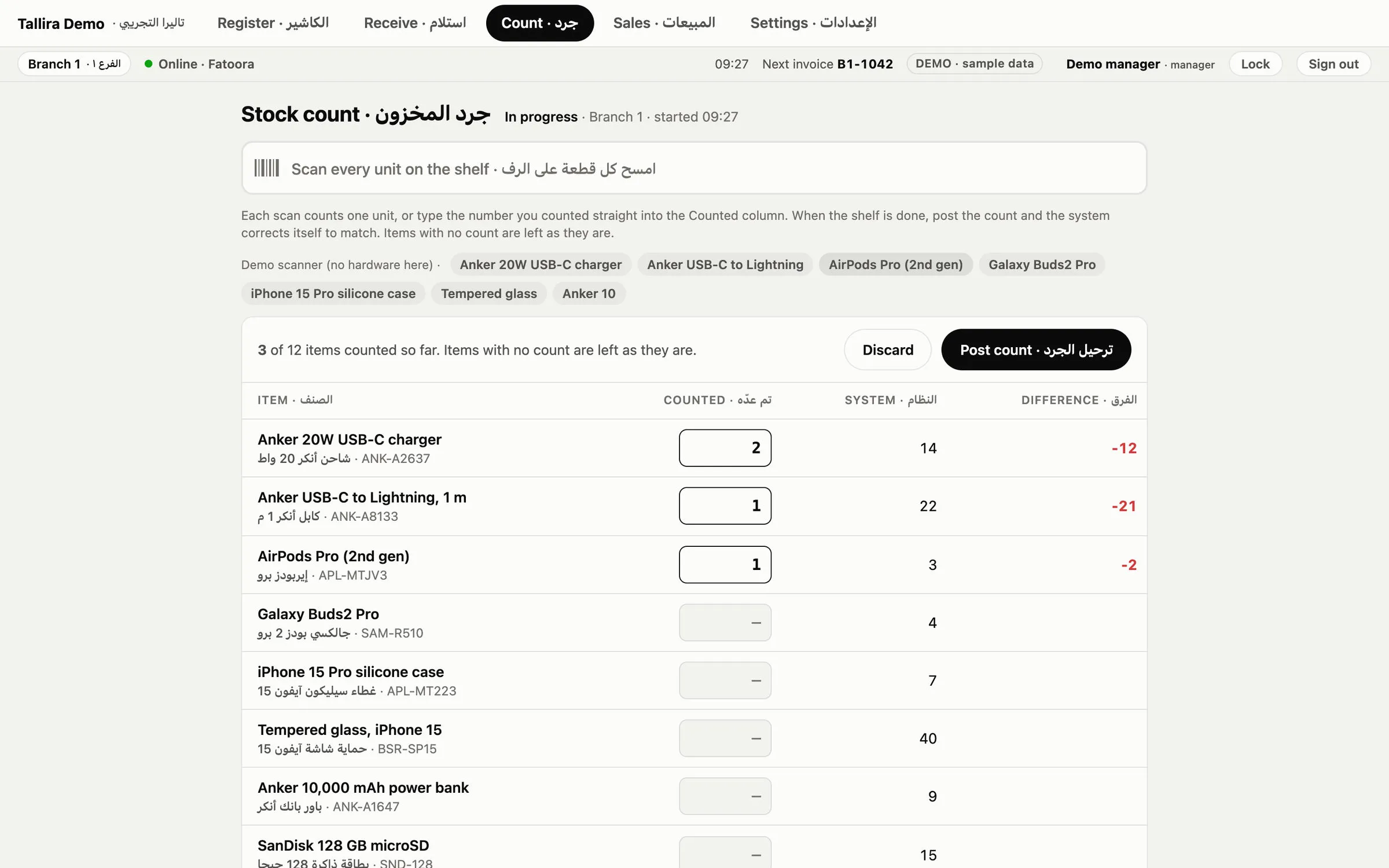
A barcode scanner is a keyboard. It types the digits and presses Enter, so the retail Sale screen keeps one scan field focused and a digit typed anywhere lands in it. Scanning adds the unit to the bill; a tap on a row adds it without the scanner. Receiving a delivery and counting a shelf are the same gesture; posting a count writes the corrections.
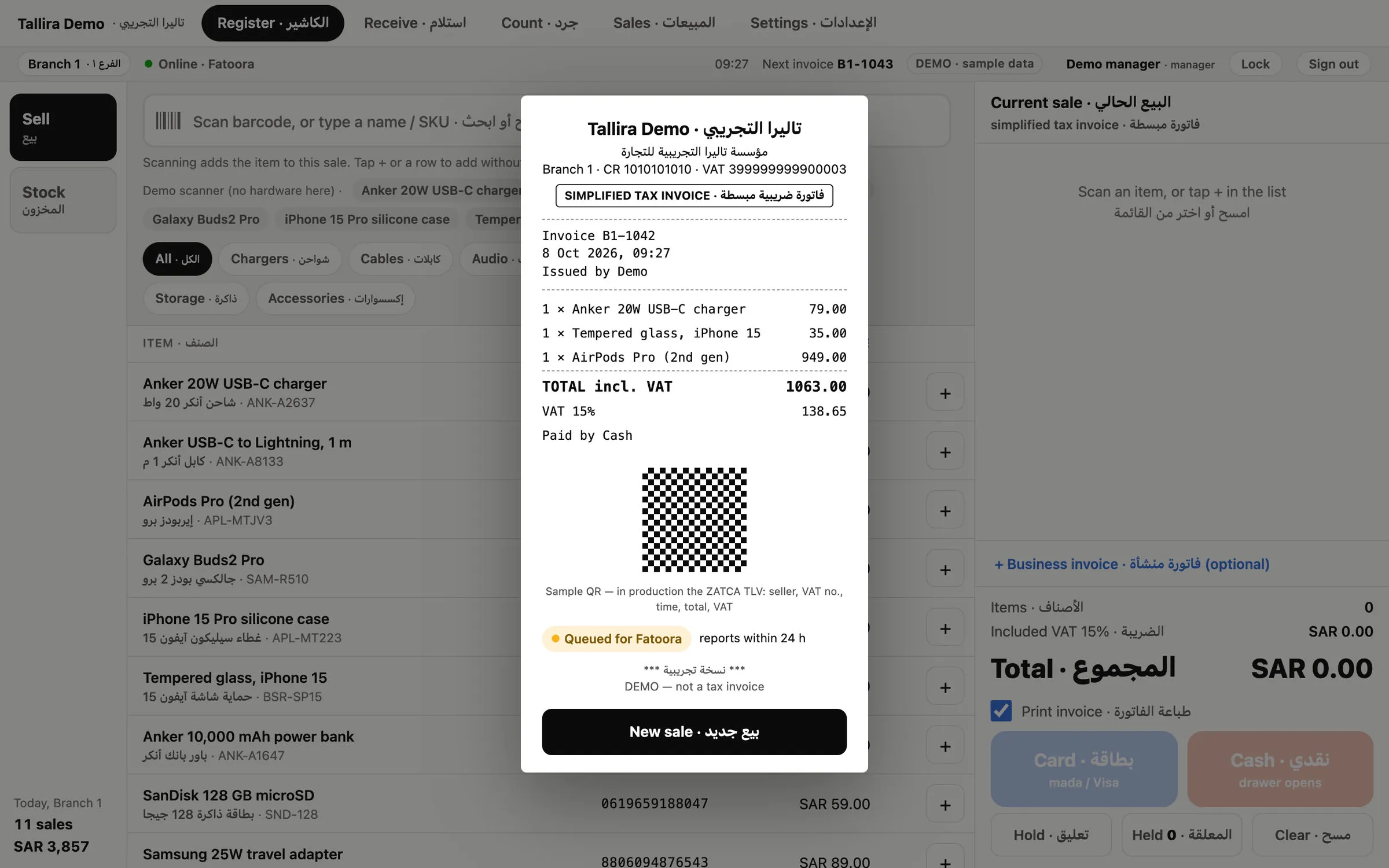
The tax invoice is the object, not the receipt. A sale in progress is a bill. Paid, it becomes a tax invoice, simplified for a walk-in customer or standard for a business that gives its tax registration number. “Do you want a bill?” is not a question the register asks; the only answer it has is which kind. The receipt prints Arabic over English on every line, each line at list price with every discount named beneath it, the way a customer checks a receipt.
A sale never waits for the network. A branch’s internet drops and the counter keeps selling, and every stock figure on screen shows how recent it is.
Owners read the business from their phone: takings by branch and register, best sellers and, on retail, stock.
Tallira is made for retailers, restaurants and cafés in Saudi Arabia and the UAE, in Arabic and English, with both editions selling from one register.
Principles
- There is no sale without a tax invoice.
- A sale never waits for the network.
- Built for the counter: big targets, both scripts, a scanner that is only a keyboard.
- A receipt reads the way a customer checks it.